

Buck Owens
BG-140A · Pat Hanks
San Francisco
James Cotton Blues Band
On the weekend of October 11-12, 1968, Bill Graham pulled off one of his most audacious programming gambits: while Jimi Hendrix burned down Winterland across town (a three-night Winterland run, Oct 10-12), Buck Owens and His Buckaroos held court at the Fillmore West for two nights, playing the hardest, sharpest honky-tonk country music in America to an audience of San Francisco hippies. It was pure Graham — the man who believed that good music was good music, genre be damned, and that his audiences were smart enough to follow him anywhere.
Buck Owens was, by 1968, one of the biggest names in country music. He and his Buckaroos had spent most of the decade atop the Billboard country charts, racking up fifteen number-one singles between 1963 and 1967 alone. The Bakersfield Sound that Owens pioneered — lean, electric, stripped of the lush Nashville string arrangements — was itself a kind of rebellion, a working-class California answer to the Music Row establishment. In its own way, it shared DNA with what the San Francisco bands were doing: rejecting polish in favor of energy, preferring the honky-tonk to the studio, choosing rawness over refinement.
Tom Brumley, the Buckaroos' pedal steel guitarist, was the secret weapon. The son of gospel songwriter Albert E. Brumley, Tom had joined the Buckaroos in 1963 and helped define their sound. His pedal steel work on "Together Again" and "Tiger by the Tail" was melodic, precise, and emotionally devastating — the kind of playing that could make a grown man cry into his beer or a hippie stop mid-dance and simply listen. Among those listening that weekend, according to the lore that has attached itself to these shows, was Jerry Garcia.
Garcia's interest in country and bluegrass was not new. He had played banjo before he ever picked up an electric guitar, and his musical education was rooted in the folk and old-time traditions of the American South. But hearing Brumley's pedal steel live, in the intimate setting of the Fillmore West, reportedly crystallized something. Within months, the Grateful Dead would begin their pivot toward the country-inflected sound of "Workingman's Dead" and "American Beauty," and Garcia would recruit John Dawson to form the New Riders of the Purple Sage, with Garcia himself playing pedal steel. Whether Brumley's playing that weekend was the catalyst or merely one more influence in a rich musical stew, the timing is suggestive.
The Fillmore West in October 1968 was the venue formerly known as the Carousel Ballroom, which Graham had taken over from the Grateful Dead's brief and financially disastrous attempt to run their own concert hall. Graham transformed it into the West Coast anchor of his growing empire, booking shows Wednesday through Saturday with the same curatorial ambition he had brought to the original Fillmore Auditorium on Geary Street. The room held about two thousand people and had a warmth and intimacy that Winterland, with its five-thousand-plus capacity, could not match.
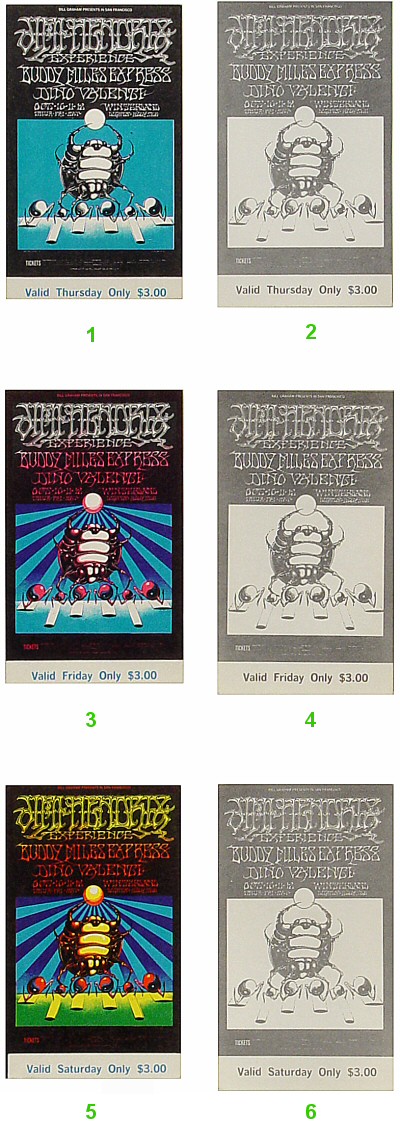
Pat Hanks designed the poster for this engagement. Hanks was not one of the "Big Five" San Francisco poster artists — Griffin, Moscoso, Mouse, Kelley, Wilson — but he was part of the broader community of designers who contributed to the Fillmore and Avalon visual culture. The poster — catalogued by collectors as BG-140A, a number no museum record confirms — is a companion piece to the Rick Griffin and Victor Moscoso collaboration that produced the scarab beetle design of BG-140 for the Hendrix shows at Winterland. Where Griffin and Moscoso went Egyptian-mystical, Hanks worked in a style that reflected the different energy of the Fillmore West bill.
The broader context of this weekend matters. October 1968 was a month of endings and beginnings. Across town at Winterland, Hendrix was playing some of the last American shows of a touring schedule that would soon wind down — with Electric Ladyland (released that very week, October 16, 1968) he had just closed one chapter, and 1969 would go to the sprawling, unfinished sessions that became his final studio work. The counterculture itself was entering a darker, more complicated phase. The Summer of Love was sixteen months gone. The Democratic Convention in Chicago had erupted in violence that August. Martin Luther King Jr. and Robert Kennedy had been assassinated that spring. Richard Nixon would be elected president in less than a month.
Against that backdrop, the simple act of booking Buck Owens at the Fillmore West carried a meaning beyond mere eclecticism. Graham was asserting that the counterculture did not have to be a closed system, that the longhairs and the cowboys were not natural enemies, that America's musical traditions belonged to everyone. It was an integrationist vision — not in the racial sense alone, though Graham was deeply committed to that as well, but in the broader cultural sense. The Fillmore West was a room where you could hear Indian ragas on Wednesday, British blues on Thursday, San Francisco acid rock on Friday, and Bakersfield country on Saturday, and no one thought it was strange.
Buck Owens, for his part, seemed to enjoy the experience. The Buckaroos were a formidable live band — tight, swinging, capable of playing at a level that commanded respect from any audience. Owens himself was a natural entertainer, comfortable in his rhinestone-studded suit in a room full of tie-dye and denim. The cultural distance between Bakersfield and the Haight was vast, but the musical distance was shorter than anyone expected.
These shows have become one of those storied footnotes in San Francisco music history — the kind of cross-pollination that could only have happened in that city, at that moment, under the direction of a promoter who saw connections where others saw contradictions.
Verification Notes
ANTAGONIZED 2026-10-06 (headless). Buck Owens & the Buckaroos at Fillmore West, SAME weekend as the Hendrix Winterland cross-booking: VERIFIED (COAU + V&A poster E.390-2004 Tea Lautrec Litho). CORRECTED: Buck Owens played Oct 11-12 1968 (Fri-Sat), TWO nights -- COAU has NO 10/10 Buck Owens entry; start_date fixed 1968-10-10 -> 1968-10-11. (The weekend spans 10-10..10-12 only because the HENDRIX Winterland booking is 3 nights.) CORRECTED: 'spent much of 1969 in the studio on Electric Ladyland' was FALSE -- EL released Oct 16 1968; 1969 = First Rays / Cry of Love / Band of Gypsys. HEDGED: catalog 'BG-140A' is a collector designation, no museum record confirms the number (V&A holds the poster with no BG number) -> softened in prose. Pat Hanks designer rests on a single V&A-derived hit -> attributed, not ironclad. Garcia/Brumley pedal-steel story kept as flagged speculation.
Were You There?
Do you have memories of this show, or an original BG-140A poster? On This Day in Art Rock History celebrates the people who lived through the psychedelic era. Your stories and collections matter to this archive.
Comments