

Chief Josh Apache
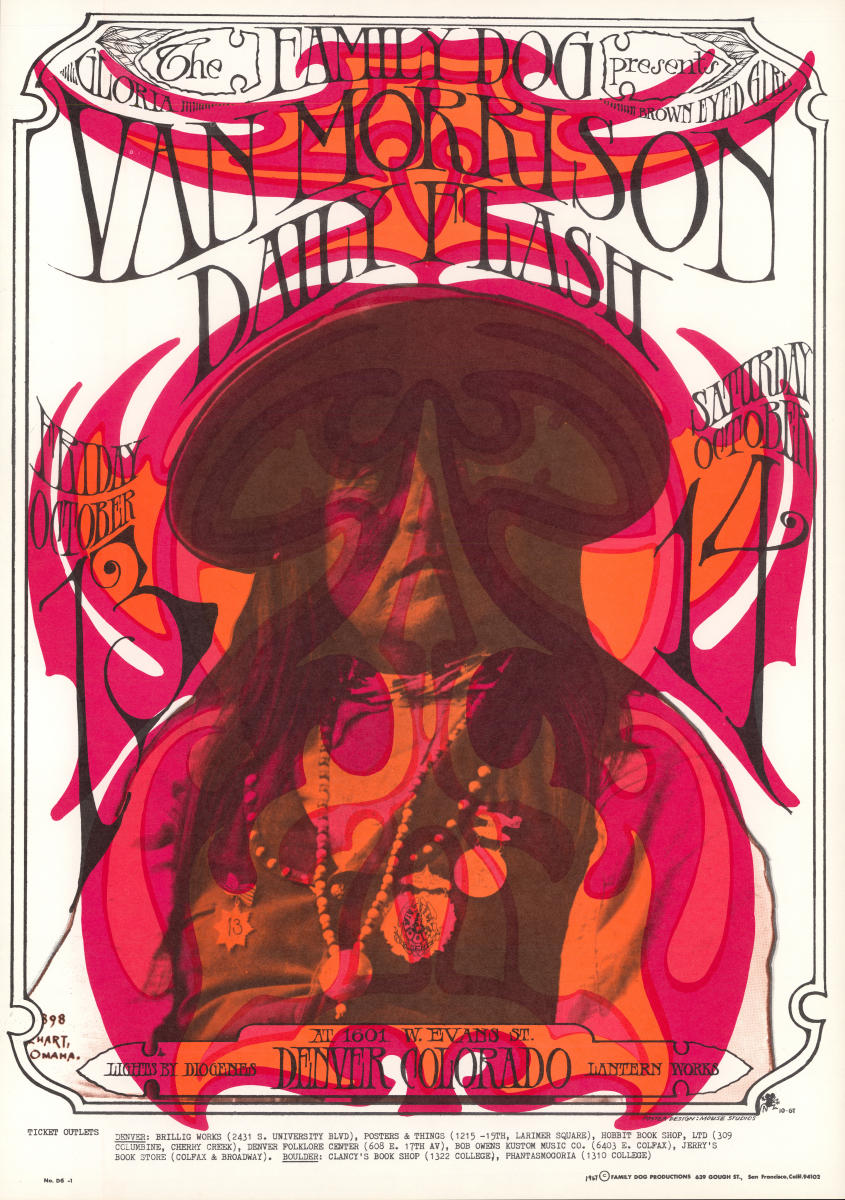
FDD-6 · Alton Kelley, Stanley Mouse
Denver
Daily Flash
On the night of October 13, 1967, at 1601 West Evans Avenue in Denver, a young Van Morrison took the stage in a venue that was trying to transplant the San Francisco psychedelic experience to the Rocky Mountain West. The Family Dog Denver was barely a month old, and already it was becoming clear that the experiment would be both magnificent and doomed.
The Family Dog had been born in San Francisco in the fall of 1965, when a loose collective of friends — Luria Castell, Ellen Harmon, Alton Kelley, Jack Towle — began throwing dance concerts at Longshoremen's Hall and other borrowed spaces. By 1966, the Family Dog had found its permanent home at the Avalon Ballroom and established itself as the countercultural alternative to Bill Graham's more businesslike Fillmore operation. Chet Helms, who had taken over management, ran the Avalon with a communal spirit that reflected the Haight-Ashbury ethos: the music was the point, the community was the vessel, and the money would work itself out.
Denver was supposed to be the expansion. The idea was seductive — take the Family Dog model to a new city, spread the gospel of psychedelic community beyond the Bay Area. The venue at 1601 West Evans was a cavernous repurposed industrial space that the Dog faithful converted into a dance hall with light shows, posters, and the same anything-goes atmosphere that made the Avalon feel like church for the counterculture. It opened in September 1967, and for a few glorious months, it worked.
The poster for this show was designed by Stanley Mouse and Alton Kelley, the same team that had created the immortal "JOB rolling paper logo" poster for FD-29 and the iconic Grateful Dead skull and roses. Mouse and Kelley were among the most gifted graphic artists of the psychedelic era, and their work for the Family Dog Denver series — done from San Francisco for the Denver operation — maintained the visual standard that had made the Family Dog's poster art famous. FDD-6, nicknamed "Chief Josh Apache," is characteristic of their collaborative approach, blending illustration with a graphic boldness that leapt off telephone poles and head shop walls.
Van Morrison was twenty-two years old and in the wilderness. He had left Them — the Belfast band that had given the world "Gloria" and "Here Comes the Night" — in late 1966, and his solo career was in an awkward infancy. His debut solo single, "Brown Eyed Girl," had been released that June and reached number ten on the Billboard Hot 100, but Morrison's relationship with his producer Bert Berns and Bang Records was already disintegrating. Berns had pushed Morrison toward pop singles; Morrison was pulling toward something deeper, stranger, more personal. The album that "Brown Eyed Girl" appeared on — "Blowin' Your Mind!" — had been released in September 1967 without Morrison's approval, assembled from session tapes by Berns. Morrison was furious.
So the Van Morrison who appeared at 1601 West Evans in October 1967 was a man between identities. He was no longer the snarling R&B frontman of Them, and he had not yet become the mystic poet of "Astral Weeks," which was still a year away. He was playing shows where he could get them, working through material that owed something to the blues, something to jazz, and something to a Celtic folk tradition that he was only beginning to consciously explore. For the Denver audience, this was a chance to see a musician in transition — raw, uncertain, brilliant, and angry in a way that gave his performances a desperate intensity.
The Daily Flash, the support act billed below Morrison, were a Seattle band who had been part of the Pacific Northwest's psychedelic scene since 1965. Steve Lalor's guitar work and the band's folk-rock experimentalism made them natural fits for the Family Dog circuit. After relocating to the Bay Area in 1966 they were part of the San Francisco / Family Dog circuit, and were known quantities in the West Coast underground. By October 1967, they were nearing the end of their run — the band would break up the following year without ever having released the album they deserved — but in concert they remained a powerful act.
The broader moment was extraordinary. October 1967 was the month when the counterculture collided head-on with the establishment. On October 21, just eight days after this show, the March on the Pentagon would bring a hundred thousand antiwar protesters to Washington. In San Francisco, the Haight-Ashbury community had staged the "Death of Hippie" mock funeral on October 6, a week before this Denver show, declaring the end of the Summer of Love and mourning what commercialism and media attention had done to their neighborhood. The original Monterey Pop Festival was four months past; its promise of music as a vehicle for peace and understanding was already beginning to curdle.
In Denver, the Family Dog operation existed in a kind of bubble — connected to San Francisco's energy but removed from its burnout. For a few months, 1601 West Evans was what the Haight had been in 1966: a place where the dream still felt possible, where a room full of strangers could become a community through the shared experience of music and light. But the Denver venue faced its own pressures — complaints from neighbors, trouble with local authorities, the financial strain of running a concert hall on idealism and thin margins. The Family Dog Denver would survive into 1968 but not much further, closing its doors in July 1968 after a run that lasted barely ten months.
What made the Family Dog Denver shows matter, beyond the individual performances, was the proof of concept they represented. The San Francisco psychedelic scene was not just a local phenomenon — it was exportable, reproducible, a model for how communities could organize around music and art. That the Denver experiment ultimately failed financially does not diminish what it achieved culturally. For the young people of Denver's nascent counterculture, 1601 West Evans was their Avalon Ballroom, their sacred space, the place where they first understood what was possible.
Verification Notes
ANTAGONIZED 2026-10-06 (pass 1, headless). check-claims OK (chickenonaunicycle+wolfgangs). CORRECTED: (1) bill order -- Van Morrison HEADLINED, Daily Flash was support below him (COAU + Wolfgang's); draft had it inverted. (2) venue lifespan -- Family Dog Denver opened Sept 8 1967, closed July 19 1968 (~10 months), NOT 'over a year'. HEDGED: 'former supermarket' unsourced -> 'repurposed industrial space'; Daily Flash 'Avalon multiple times' unsourced -> softened to the FD circuit. KEPT (antagonist overruled the brief's suspicion): designer = Stanley Mouse AND Alton Kelley (Mouse Studios) -- Wolfgang's + gocollect + V&A all credit both; COAU's solo-Mouse is the outlier. VERIFIED: Brown Eyed Girl (June 1967, #10), Blowin' Your Mind! (Sept 1967, released w/o consent by Bert Berns/Bang), Death of Hippie Oct 6 1967, March on Pentagon Oct 21 1967, Morrison age 22. Browser-only: classicposters/famsf.
Were You There?
Do you have memories of this show, or an original FDD-6 poster? On This Day in Art Rock History celebrates the people who lived through the psychedelic era. Your stories and collections matter to this archive.
Comments