

Electric Flag / Moby Grape / Southside Sound System (night 2)
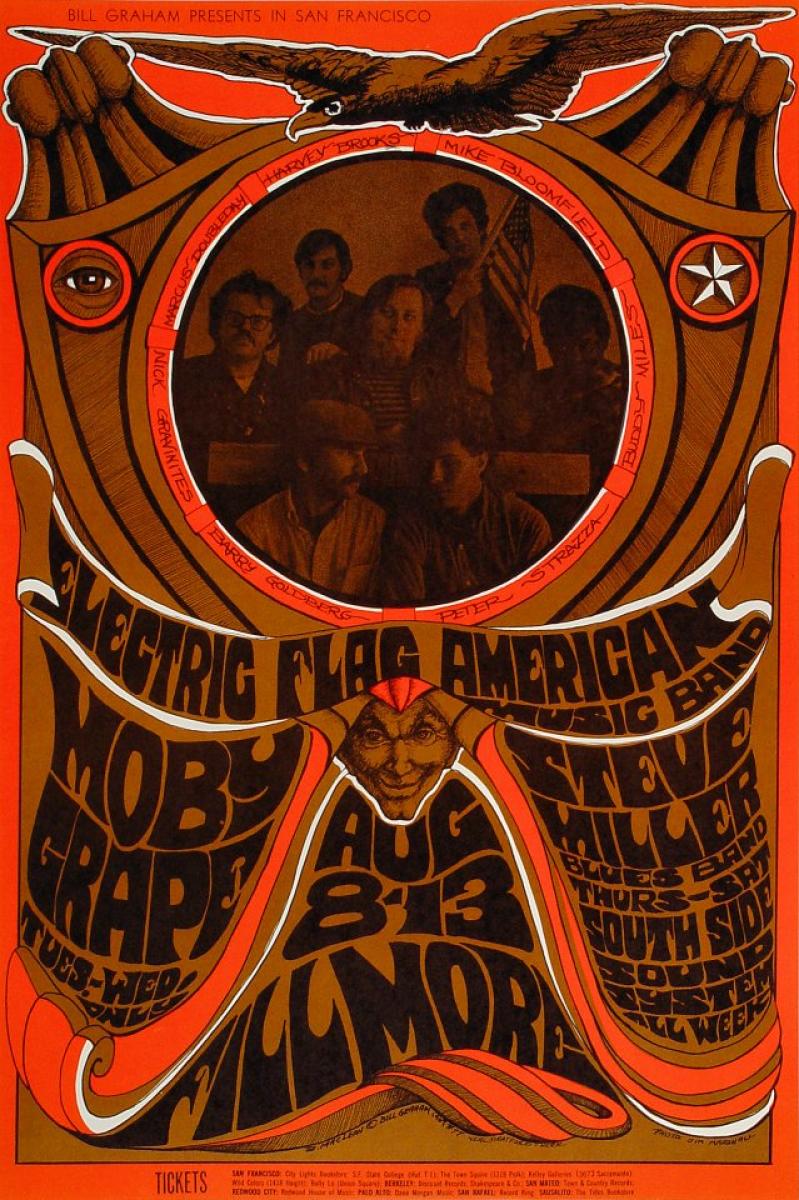
BG-77 · Bonnie MacLean
San Francisco
Moby Grape
Southside Sound System
August 9, 1967 was a Wednesday, and it is the hero of this date by the chronicle's own placement rule — oldest year, anchored by a poster — as the second night of the Electric Flag / Moby Grape / Southside Sound System run at the Fillmore Auditorium under Bonnie MacLean's BG-77. It was also Moby Grape's last of two Fillmore nights before the band crossed to the Avalon; the fuller story of that engagement sits on August 8. But August 9 is really a day whose interest is spread across two later Fillmore West and Avalon bills a year on, in 1968, and the chronicle notes both as co-leads.
The first is one of the earliest important Santana appearances the scene has on record. On August 9, 1968 — a Friday — the Avalon Ballroom opened a three-night run, Steppenwolf headlining, the Siegel-Schwall Band second, and Santana at the bottom of the bill, under Family Dog poster FD-132. The designer was Billy Glover; the Smithsonian American Art Museum holds the piece and titles it "Aurora," dating it August 9–11, 1968. Santana in August 1968 was barely a year old as a working band and more than a year from the debut album; to find it third-billed at the Avalon, under Steppenwolf ("Born to Be Wild" was climbing the charts that very month) and the Chicago blues of Siegel-Schwall, is to catch Carlos Santana's band in the long apprenticeship before Woodstock made it famous. Two vetted records — the Smithsonian and Corry Arnold's Steppenwolf show-list — independently confirm the bill and the dates.
The second co-lead is across town the same weekend. The Fillmore West's BG-132 — the single Lee Conklin poster that opened August 6 with the Chambers Brothers — carried a second bill on its back half: Eric Burdon and the Animals, Blood, Sweat and Tears, and the Gypsy Wizard Band, August 9 through 11, with lights by the Holy See. This is the source of a persistent cataloguing error worth flagging, because a first research pass guessed the Burdon bill carried its own number (BG-134). It does not. BG-134 is a different poster entirely — the Grateful Dead and Santana at the Fillmore West, the Conklin image that would become the Santana debut LP cover. The Eric Burdon bill shares BG-132 with the Chambers Brothers; one six-night poster, two three-night bills. The Grateful Dead Archive Online preserves the full BG-132 record and settles it.
There is a Matrix thread on this date too, in 1969. The New Riders of the Purple Sage — the country-rock offshoot that grew out of Jerry Garcia's interest in the pedal steel — were in the middle of a Matrix stand that jerrybase and Corry Arnold's lostlivedead frame as roughly August 6 through 9, 1969, with Garcia on pedal steel and Mickey Hart on drums alongside John Dawson and David Nelson. The rock-solid, documented night of that stand is Thursday, August 7 (a soundboard tape survives, and it is essentially the first gig under the "New Riders" name); August 9 sits at the tail of the run, so the chronicle notes the New Riders' Matrix week rather than asserting a discrete, separately-documented August 9 show. The Matrix printed no posters, so there is no artifact — an honest absence, not a gap.
So August 9 is a layered day: the anchored 1967 hero (Electric Flag's BG-77), a very early third-billed Santana at the Avalon in 1968, an Eric Burdon bill that has been mis-numbered for years, and Garcia moonlighting on pedal steel at the Matrix in 1969 — the scene, on one late-summer Wednesday-and-Friday, doing four different things at once.
Verification Notes
ANTAGONIST-CHECKED. VERIFIED: 1967-08-09=Wednesday; 2nd night of BG-77 and Moby Grape's LAST Fillmore night before crossing to the Avalon (FD-75). HERO of 08-09 by the placement rule (oldest anchored year). Co-leads this date are the 1968 Avalon (FD-132) and Fillmore West (BG-132) bills below.
Were You There?
Do you have memories of this show, or an original BG-77 poster? On This Day in Art Rock History celebrates the people who lived through the psychedelic era. Your stories and collections matter to this archive.
Comments