

FD-142
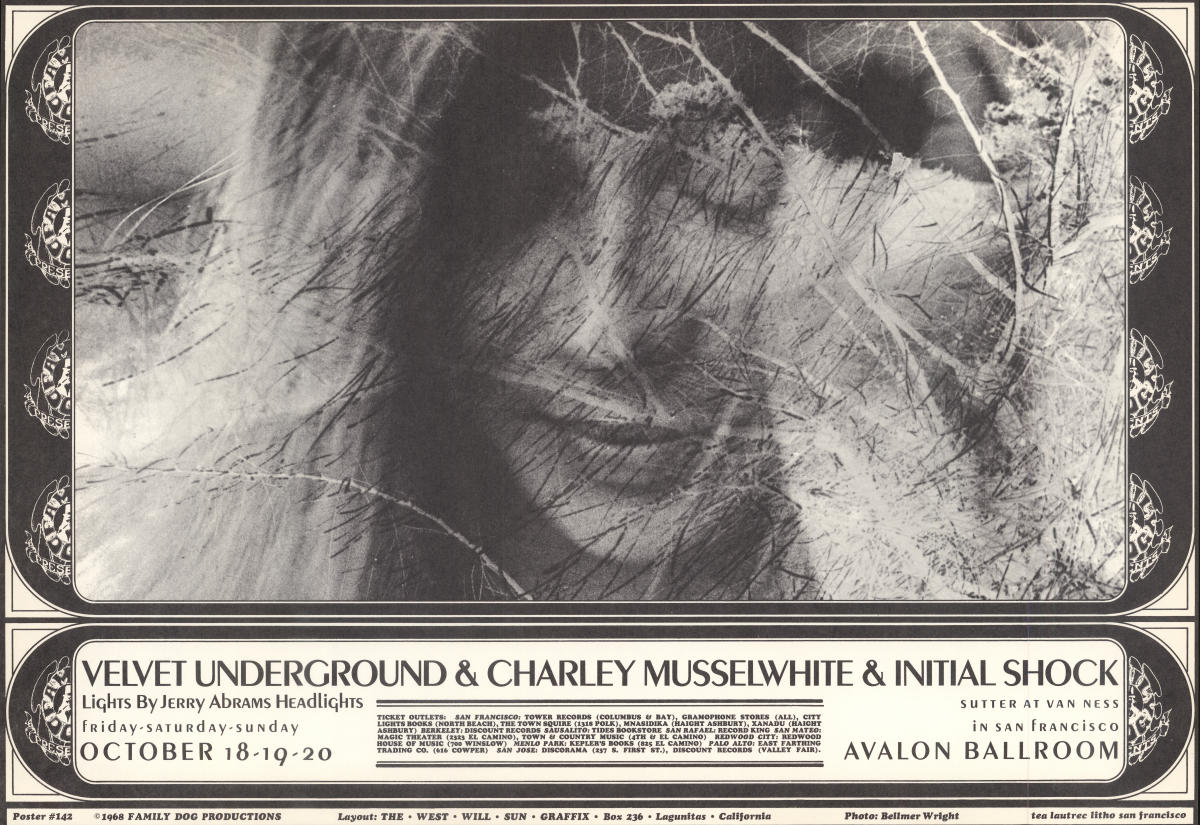
FD-142 · Wes Wilson
San Francisco
Charlie Musselwhite
Initial Shock
On Friday, October 18, 1968, a poster by Wes Wilson went up for a three-night Family Dog weekend at the Avalon Ballroom — FD-142 in the numbered series — and the name across the top was one that had no business feeling at home there: the Velvet Underground. Chet Helms's Avalon was the warm, communal, light-show heart of the San Francisco scene, and the Velvets were its temperamental opposite: a New York band forged in Andy Warhol's Factory, dressed in black, playing songs about heroin and sadomasochism with a deadpan hostility to flower-power uplift. That tension — Manhattan avant-garde dropped into the middle of Haight-Ashbury's ballroom circuit — is the story of the weekend, and it is worth telling carefully, because the band that showed up was not quite the band most people picture.
By October 1968 the Velvet Underground had just been remade. John Cale — the Welsh classically-trained violist and bassist whose drones and dissonance had defined the first two albums — had played his last show with the group at Boston's Tea Party in late September (chronologies, including the account at pleasekillme.com, put it at September 28) before Lou Reed forced him out. His replacement, a young Bostonian named Doug Yule, joined at the very start of October and made his live debut barely a week later at La Cave in Cleveland over the weekend of October 4–6. So when the band hit the Avalon two weeks after that, the lineup was Reed, Sterling Morrison, Maureen Tucker, and Yule — the post-Cale configuration that would record the gentler, more song-shaped third album, *The Velvet Underground*, in Hollywood later that autumn (it came out in March 1969). The ferocious *White Light/White Heat*, released that January, had been Cale's last testament; the Avalon audience in October was hearing the group in transition, already softening at the edges even if nobody in the room could have known the arc. (A fair caveat: the dates bracket this run cleanly, but no surviving source I found names the four players on the Avalon stage those particular nights — the lineup is an inference from Cale's exit and Yule's arrival, not from a review of the show.)
The support was local and bluesy, a telling contrast to the headliner. Charley Musselwhite — the spelling the poster and the Family Dog ledger use, and the one on his own debut LP, though he is usually "Charlie" — was a Chicago-schooled blues harmonica player who had relocated to the Bay Area and whose *Stand Back! Here Comes Charley Musselwhite's Southside Band* (Vanguard, 1967) had made him a name among blues listeners. Below him on the bill was Initial Shock, a San Francisco band about whom reliable detail is thin; they belong to the long tail of local groups the Avalon rotated through its weekends, and I can confirm little beyond their presence on FD-142.
The poster credit itself deserves a word, because it looks at first like exactly the kind of thing that turns out to be wrong. Wes Wilson is one of the canonical "Big Five" San Francisco poster artists, famous for the melting, fire-breathing lettering of the early Fillmore and Avalon handbills — and famous, too, for walking away in 1967. But the 1967 rupture was with Bill Graham and the Fillmore, over money; it was not a break with Chet Helms's Family Dog, and Wilson was demonstrably still producing Avalon work that very month — the Poster House collection confirms he drew the adjacent FD-140. Both Chicken on a Unicycle and the University of Delaware's Special Collections credit FD-142 to Wilson. The one wrinkle worth flagging: those same sources credit Wilson for the whole consecutive block FD-140 through FD-143, and a uniform run of identical credits is the sort of pattern that can hide a catalog carry-forward error. Nothing found here refutes Wilson — a dealer listing floating the name "Bellmer Wright" is unsupported and best ignored — but a direct look at the poster's own signature would be what makes the attribution unassailable.
What lingers is the collision: Chet Helms, the gentlest of the SF impresarios, booking the coldest band in American rock into his ballroom, two weeks into its reinvention, with a Chicago blues harpist and an all-but-forgotten local act beneath them. Whatever happened on those three nights, the bill itself is the artifact — a document of two scenes brushing past each other at an odd, transitional moment for both.
Verification Notes
RESEARCHED+ANTAGONIZED 2026-10-06 (headless). The Velvet Underground / Charley Musselwhite / Initial Shock, Avalon, Oct 18-20 1968 (Fri-Sun). check-claims OK (chickenonaunicycle+wolfgangs). LINEUP FINDING: this is the DOUG YULE (post-Cale) VU -- Cale's last show Boston Tea Party Sept 28 1968, Yule debuted La Cave Cleveland Oct 4-6 1968 (pleasekillme + VU Wikipedia + lostlivedead); by Oct 18 Yule 2 weeks in. Calling it Cale-era would be a hard error. HONEST CAVEAT: no source names the 4 players on the Avalon stage those nights -- a tight chronological inference, stated as such. Designer WES WILSON verified-with-reservation (COAU + UDel both credit Wilson; Wilson's 1967 split was with GRAHAM, not Helms, so a late-1968 FD credit is plausible) BUT COAU credits Wilson for the whole FD-140..143 block (possible carry-forward default) -> flagged for a signature read. 'Charley' spelling period-correct (matches his 1967 LP). 1stdibs 'Bellmer Wright' credit dismissed as dealer error. Initial Shock: on bill, no profile found. Browser-only (classicposters/famsf) for signature + printed order.
Were You There?
Do you have memories of this show, or an original FD-142 poster? On This Day in Art Rock History celebrates the people who lived through the psychedelic era. Your stories and collections matter to this archive.
Comments