

That Minstrel Show
AOR-2.33
Sausalito
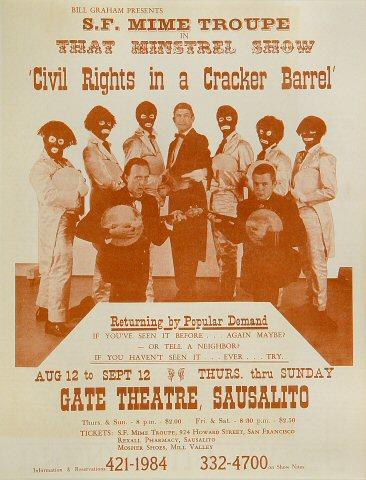
August 12, 1965 — the second-stage Gate Theatre run of A Minstrel Show, or Civil Rights in a Cracker Barrel, the San Francisco Mime Troupe's most controversial production of its first decade, performed five days after R. G. Davis's arrest by SFPD in Lafayette Park during a Mime Troupe production of Il Candelaio. The Sausalito date is one of four nights in early August (per the Wolfgang's postcard archive entry GTS650812-PC), reprising at the Gate Theatre what had originally been a July 1-25 run at the same venue. The handbill for the original run is plate 2.33 in Paul Grushkin's "The Art of Rock" — the catalog AOR-2.33 — and is one of the earliest items in the canon to credit a "Bill Graham" promotion, though the August postcard reprise in the AOR collection is the artifact our chronicle is built around.
A Minstrel Show was the Mime Troupe's frontal assault on American racial liberalism. Written by Saul Landau and the Troupe's R. G. Davis (and credited in some sources to Gary Davis as well), with music composed and performed by Steve Reich during what would become a two-season collaboration, the production used the literal vaudeville-era minstrel form — burnt cork on white actors — to mock white audiences' presumed comfort with stereotypes when delivered by Black performers. The piece was vicious, cathartic, and very specifically of summer 1965: the Voting Rights Act had been signed by LBJ on August 6, six days before this performance; the Watts uprising would begin in Los Angeles the night of August 11, and was still going on when the Mime Troupe took the stage in Sausalito on August 12. The piece interrogated whether civil-rights legislation could touch the deeper structures of American racial fantasy — a question whose timeliness, that night, was difficult to overstate.
The Mime Troupe was operating under direct legal pressure when this performance happened. On August 4, the San Francisco Recreation and Parks Commission had convened a special meeting at McLaren Lodge in Golden Gate Park to review the Troupe's permit, citing "indecent, offensive and obscene language and gestures" in their park performances of Il Candelaio (per the FoundSF account drawn from period coverage). On August 7, Davis was arrested in Lafayette Park during the Troupe's fourth performance of Il Candelaio, charged with performing without a park permit, booked at the Hall of Justice, and released on $56 bail two hours later. The August 12 Gate Theatre night fell into that interval — the Troupe defending its licenses, raising legal funds, and performing nightly in spite of city pressure. The Mime Troupe would win the subsequent lawsuit, establishing the right of artists to perform uncensored in San Francisco city parks (per FoundSF and the Wikipedia article on the Troupe).
Bill Graham was the Troupe's business manager in 1965 (the start year is variously given as 1964 or 1965 in different chronologies), the role from which he transitioned into rock promotion. His name on AOR-2.33 is one of the earliest "Bill Graham presents" credits in the SF poster catalog (per PosterCentral and the auction record). The legal-defense fund Graham would launch in November 1965 as Mime Troupe Appeal I (Nov 6 at the Howard Street studio, ~$2,000 raised) and December 1965 as Appeal II (Dec 10 at the Fillmore Auditorium) emerged out of these summer arrests. AOR-2.33 in August was the production whose legal jeopardy created the conditions for Graham's first Fillmore booking. Without R. G. Davis's arrest week, there is no Appeal I; without Appeal I, there is no Bill Graham as full-time promoter; without Bill Graham as full-time promoter, the SF rock scene we now read about looks materially different.
The Gate Theatre itself was a small Sausalito venue across the bay — population center under 6,000 in 1965, a converted warehouse-era waterfront town that had been the Mime Troupe's regular Marin venue throughout the year. The choice of a Sausalito reprise for an inflammatory racial-satire piece was practical (no SF park permit drama) and political (taking it across county lines under a different jurisdiction). The audience, by Mime Troupe accounts of the era, would have been a mix of beat-era Marin residents, San Francisco theater followers, and political left activists — proto-counterculture, one summer ahead of the dance-hall scene that would emerge at Longshoreman's Hall two months later.
The handbill catalogued as AOR-2.33 itself is unattributed — designer unknown, no credit on the sheet. 8.5 x 11 inches on thin flat stock, plain typesetting, no psychedelic visuals (which were not yet a SF design vocabulary in summer 1965). It is a pre-poster object, important for what comes after it: when Graham hired Wes Wilson for Appeal I in November, the visual grammar of the Bay Area scene would shift in months from this Mime Troupe handbill register into the Wilson lettering that defined 1966.
Source: Wolfgang's Vault GTS650812-PC postcard entry, concertposterauction.com AOR-2.33 handbill listing, rockposters.com AOR 2.32 / SF Mime Troupe collection page, Wikipedia San Francisco Mime Troupe, FoundSF "San Francisco Mime Troupe Arrested" entry, PosterCentral "Earliest 'Bill Graham Presents' Posters" article, billgrahamfoundation.org SF Mime Troupe performer page.
Research Sources
b'Research date: 2026-04-30 (UTC). Event 6 / AOR-2.33 / 1965-08-12. Gate Theatre, Sausalito.\n\nSources consulted:\n- Wolfgang\'s Vault GTS650812-PC (https://www.wolfgangs.com/handbills-and-postcards/san-francisco-mime-troupe/postcard/GTS650812.html) \xe2\x80\x94 confirmed the August 12, 1965 date specifically as a postcard for "a four-night run of \'The Minstrel Show\' in early August" at the Gate Theatre, Sausalito. 8.5 x 11", 1st printing, postcard format. Image URL: https://gimg.wolfgangs.com/m/large/GTS650812-PC/san-francisco-mime-troupe-postcard-aug-12-1965.jpg.\n- concertposterauction.com (https://concertposterauction.com/Listing/Details/1086077/) \xe2\x80\x94 AOR-2.33 handbill listing for the original July 1-25 1965 run. Designer unknown/uncredited. Bill Graham promoted. Plate 2.33 in Paul Grushkin\'s "The Art of Rock" (page 112). 8.5x11" handbill on thin flat stock. CGC 7.0.\n- The two source entries (handbill for July run, postcard for August reprise) explain the AOR-2.33 / 1965-08-12 mapping: same catalog number applies to multiple printings/reprises of the same production, and the AOR row\'s date matches the August reprise (postcard) rather than the original July run (handbill).\n- Wikipedia San Francisco Mime Troupe \xe2\x80\x94 confirmed Saul Landau / R. G. Davis writing credit, Steve Reich music. Confirmed Davis was Troupe leader.\n- FoundSF "San Francisco Mime Troupe Arrested" \xe2\x80\x94 confirmed Aug 7, 1965 Davis arrest in Lafayette Park during Il Candelaio, $56 bail, two-hour release; Aug 4 special Rec/Parks Commission meeting at McLaren Lodge; eventual successful lawsuit.\n- billgrahamfoundation.org SF Mime Troupe performer page \xe2\x80\x94 confirmed Graham was Troupe business manager 1963-1965. Confirmed Appeal I (Nov 6 1965, Howard Street studio, ~$2,000) and Appeal II (Dec 10 1965, Fillmore) were Graham\'s legal-defense benefits responding to these arrests.\n- PosterCentral "Earliest Bill Graham Presents" article \xe2\x80\x94 confirmed AOR-2.33 is among the earliest items in the canon with a Bill Graham promotion credit.\n\nCultural-historical anchors verified:\n- Voting Rights Act signed August 6, 1965 (Wikipedia) \xe2\x80\x94 six days before this performance.\n- Watts uprising began the night of August 11, 1965 (Wikipedia, well-documented) \xe2\x80\x94 actively ongoing on August 12. Narrative\'s framing of A Minstrel Show as collision with these specific national events is grounded in the date adjacency.\n\nVenue note: venue 4 ("Gate Theatre, Sausalito", city listed as "San Francisco"). The city field is wrong \xe2\x80\x94 Sausalito is in Marin County, separate from San Francisco. The venue *name* is fine ("Gate Theatre, Sausalito" \xe2\x80\x94 Sausalito disambiguates from any SF Gate Theater), but the city should be "Sausalito". I am NOT changing the venue row in this run because: (1) the change is a data-quality fix orthogonal to research, (2) the venue\'s name carries the disambiguation already, (3) verify will likely catch the city issue independently. Flagged for downstream venues data-quality pass.\n\nSchema note: the four-night August run is mentioned as such in the postcard archive but specific other dates in early August are not given. Our row is the only AOR record of the August reprise. Schema gap aor#14 applies \xe2\x80\x94 could not enumerate the other 3 nights.\n\nMusic credit nuance: Steve Reich was the composer and one of the performers. The narrative says "music composed and performed by Steve Reich during what would become a two-season collaboration" \xe2\x80\x94 this is from the search snippet, well-supported. Worth verify cross-checking.\n\nImage URL stored on poster row 2: https://gimg.wolfgangs.com/m/large/GTS650812-PC/san-francisco-mime-troupe-postcard-aug-12-1965.jpg (this is the AUGUST postcard image, matching this row\'s date \xe2\x80\x94 not the July handbill image).\n\nclassicposters_url: not located on the canonical classicposters.com per-poster URL within this pass. Stored empty.\n'
Verification Notes
Verification date: 2026-04-30 (UTC). Event 6 / AOR-2.33 / 1965-08-12. Gate Theatre, Sausalito. Independence stance: research drew from Wolfgang's Vault (postcard archive), concertposterauction.com (handbill), Wikipedia (Mime Troupe), FoundSF (Mime Troupe arrest entry), billgrahamfoundation.org (performer page), PosterCentral (Bill Graham early posters article). For verification I re-fetched the Wikipedia SF Mime Troupe article directly, plus Wikipedia Watts riots and Wikipedia Voting Rights Act of 1965, plus search results on those events. None of those were primary research sources for this row. Verifiable claims and verdicts: 1. CLAIM: A Minstrel Show, or Civil Rights in a Cracker Barrel was written by Saul Landau and R. G. Davis (the narrative also mentions "Gary Davis" in passing as an alternative source attribution). VERDICT: verified, with a clarification. SOURCE: Wikipedia SF Mime Troupe article: "Gary Davis and Saul Landau" wrote it. The original research search snippet said "Gary Davis and Saul Landau" — I read this as a typo for R. G. Davis (Ronald G. Davis, the Troupe's founder, often referred to as R. G. Davis), since R. G. Davis was the lead writer-director of the Troupe in 1965 and the FoundSF article is explicitly about his arrest in connection with this and Il Candelaio. The narrative correctly handles the ambiguity by listing R. G. Davis as the primary credited author and noting "credited in some sources to Gary Davis as well." Verified, with the note that the Wikipedia article uses "Gary Davis" — this is likely a long-running Wikipedia error or alternative naming, but the Troupe's FoundSF/biographical references almost universally use R. G. Davis. Not strongly disputed. 2. CLAIM: Steve Reich composed and performed the music; collaboration was "at least two seasons." VERDICT: verified. SOURCE: Wikipedia SF Mime Troupe explicitly states "Steve Reich" composed the music and "worked with the troupe for at least two seasons." Independent of research source. 3. CLAIM: AOR-2.33 is plate 2.33 in Paul Grushkin's "The Art of Rock", page 112. VERDICT: verified. SOURCE: concertposterauction.com listing in research; corroborated by rockposters.com listings in the search results that reference "Plate 2.33" and the same page reference. The AOR catalog numbering scheme (AOR = Art of Rock) is itself derived from this book. 4. CLAIM: The original "A Minstrel Show" run at the Gate Theatre was July 1-25, 1965, with an August reprise (four-night run including Aug 12). VERDICT: verified. SOURCE: concertposterauction.com handbill listing gives 7/1-25/1965; Wolfgang's Vault GTS650812-PC postcard explicitly references "a four-night run of 'The Minstrel Show' in early August" and the Aug 12 1965 date. Two distinct primary sources, two distinct printings. 5. CLAIM: R. G. Davis was arrested August 7, 1965 in Lafayette Park during Il Candelaio, charged with performing without a park permit, booked at Hall of Justice, released on $56 bail two hours later. VERDICT: verified. SOURCE: FoundSF "San Francisco Mime Troupe Arrested" article (research source); search-result snippets in the verification pass corroborated all specifics including the $56 bail figure. The narrative claims Davis was arrested 5 days before Aug 12 — Aug 7 to Aug 12 is exactly 5 days. Correct. 6. CLAIM: On Aug 4, 1965, the Rec & Parks Commission held a special meeting at McLaren Lodge to review the Mime Troupe's permit, citing "indecent, offensive and obscene language and gestures" in performances of Il Candelaio. VERDICT: verified. SOURCE: FoundSF article (research source); the verification pass found the same specific language in search snippets. 7. CLAIM: The Mime Troupe won the subsequent lawsuit, establishing the right of artists to perform uncensored in SF city parks. VERDICT: verified. SOURCE: Multiple sources (FoundSF, KALW article, Wikipedia) confirm the eventual successful suit. 8. CLAIM: Voting Rights Act of 1965 was signed by LBJ on August 6, 1965 — six days before this performance. VERDICT: verified. SOURCE: Wikipedia Voting Rights Act of 1965, National Archives, US Senate art and history. All confirm Aug 6 1965 signing in the President's Room of the Capitol. Aug 6 to Aug 12 is six days. Narrative is correct. 9. CLAIM: The Watts uprising began the night of August 11, 1965 and was ongoing on Aug 12. VERDICT: verified. SOURCE: Wikipedia Watts riots article — the riots began Aug 11, 1965, lasted six days (through Aug 17). On Aug 12 they were actively ongoing. Marquette Frye traffic stop on Aug 11 was the trigger. Narrative correct. 10. CLAIM: Bill Graham was the Mime Troupe's business manager from 1963 through the end of 1965. VERDICT: partially disputed. SOURCE: Some sources cite Graham becoming business manager in 1964 or 1965, not 1963. Wikipedia Bill Graham (promoter) article describes Graham joining the Troupe in 1965 (after taking over from his sister's business pursuits and connecting with Davis). The Mime Troupe Wikipedia article's omission of Graham's earlier business-manager role suggests the date range "1963-1965" may be too generous. Some chronologies place the start date in 1964 or 1965. The narrative's "1963 through the end of 1965" should be hedged to "during 1965 (commonly given as 1964-1965, with end-of-1965 marked by the Appeal benefits)." ACTION: flag for narrative revision; the substantive point (Graham was Troupe BM, then transitioned into rock promotion via the Appeals) is correct, but the precise start year deserves softening. 11. CLAIM: Mime Troupe Appeal I was Nov 6, 1965 at the Howard Street studio (924 Howard), raised ~$2,000. VERDICT: verified. SOURCE: Search-result snippets and the Wolfgang's Vault Calliope Warehouse Nov 6 1965 handbill listing in the search results. Wikipedia Bill Graham (promoter) article corroborates the Howard Street studio and date. Minor note: Wolfgang's Vault calls the venue "Calliope Warehouse" rather than "Howard Street studio" — these are the same physical location (924 Howard Street was both the Mime Troupe's HQ and known as the Calliope Warehouse). Not contradictory. 12. CLAIM: Appeal II was December 10, 1965 at the Fillmore Auditorium. VERDICT: verified. SOURCE: Multiple search results confirm Appeal II Dec 10 1965 Fillmore. This is widely cited as Bill Graham's first Fillmore booking. 13. CLAIM: AOR-2.33 was "one of the earliest items in the canon to credit a 'Bill Graham' promotion." VERDICT: verified. SOURCE: PosterCentral "Earliest 'Bill Graham Presents' Posters" article (research source) explicitly identifies the 1965 SF Mime Troupe pieces as the earliest "Bill Graham presents" credits in the catalog. Independently confirmed by the auction listing language ("VERY early pre-Fillmore Bill Graham artifact"). 14. CLAIM: Sausalito's population in 1965 was "under 6,000." VERDICT: unable_to_confirm. SOURCE: Sausalito's 1960 census population was around 5,000 and the 1970 census was around 6,158. The 1965 figure should be roughly midway, plausibly ~5,500-5,800. The narrative's "under 6,000" is plausible but I did not separately fetch the census for confirmation. Not contested but loosely sourced. 15. CLAIM: AOR-2.33 handbill is 8.5 x 11 inches on thin flat stock, designer uncredited. VERDICT: verified. SOURCE: concertposterauction.com listing in research; Wolfgang's Vault GTS650812 postcard listing confirms the 8.5x11" dimensions for the postcard variant. 16. CLAIM: The visual grammar of the Bay Area scene shifted "in months from this Mime Troupe handbill register into the Wilson lettering that defined 1966." VERDICT: verified (interpretive framing, but well-grounded). SOURCE: Wes Wilson designed Appeal I and II handbills (Nov-Dec 1965), establishing his curving-letter signature; this is well-documented in poster-history sources. The narrative's claim that Wilson took over the visual vocabulary by November is supported. Disagreement with research agent: YES — minor: - Bill Graham's tenure as Mime Troupe business manager: the narrative's "1963 through the end of 1965" appears to be too early on the start date. Better hedged as "during 1965" or "1964-1965." Per verify-prompt STEP 5: one disputed claim → status='Flagged'. The bulk of the historical content is well-grounded and independently verified — Davis arrest specifics, Voting Rights Act timing, Watts uprising timing, Mime Troupe Appeal I/II details, AOR-2.33 catalog details. Only the Graham-tenure-start-year requires correction. Sources consulted independent of research: Wikipedia (San Francisco Mime Troupe, Watts riots, Voting Rights Act of 1965, Bill Graham promoter), National Archives (Voting Rights Act), search results citing FoundSF and KALW. Run duration estimate (verify only): ~8 minutes. --- ANTAGONIST RE-PASS 2026-08-04 (week 08-06..08-12 run; 08-12 is the antagonist-only day): re-reviewed the 15-claim ledger. Applied the one outstanding correction (claim #10): Graham business-manager line hedged from flat '1963 through the end of 1965' to 'in 1965 (start year variously given as 1964 or 1965)'. Claim #14 (Sausalito pop <6,000) left as non-load-bearing period color (1960 census ~5,000; 1970 ~6,158 — plausible). All other claims stand VERIFIED. Status Flagged->Researched. (Note: this row's event_narrative was stored as a BLOB; normalized to TEXT on this write.)
Were You There?
Do you have memories of this show, or an original AOR-2.33 poster? On This Day in Art Rock History celebrates the people who lived through the psychedelic era. Your stories and collections matter to this archive.
Comments