

Big Mama
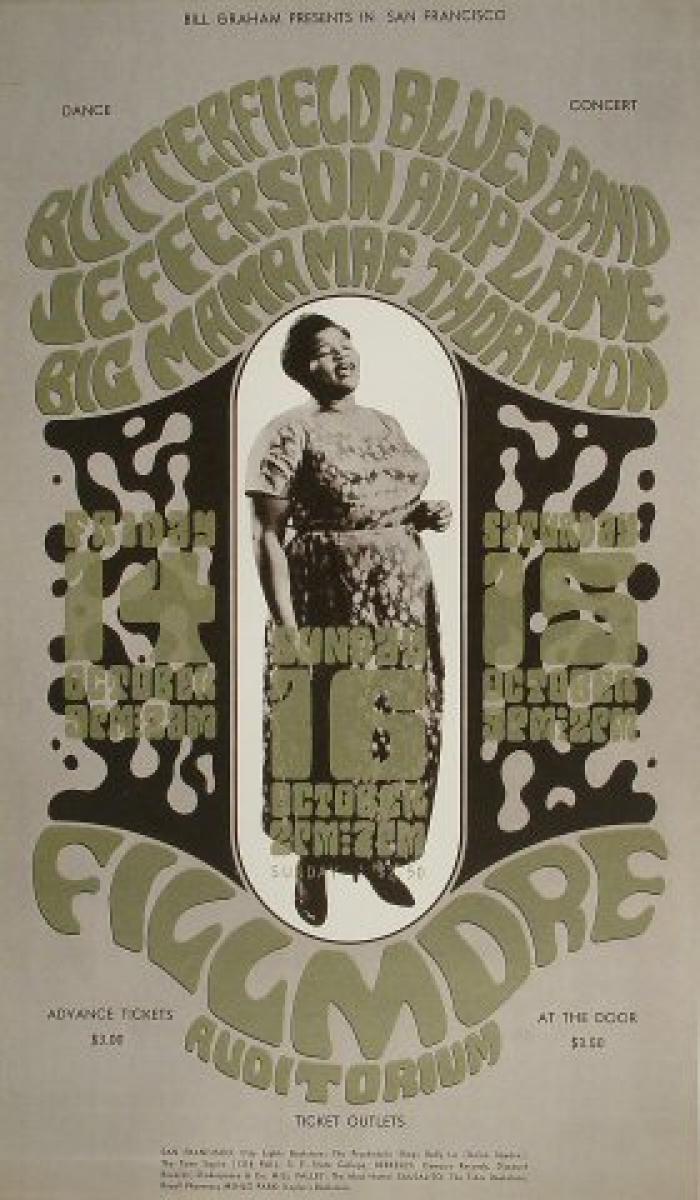
BG-31 · Wes Wilson
San Francisco
Jefferson Airplane
Big Mama Thornton
On Friday, October 14, 1966, the Fillmore Auditorium opened a three-night Bill Graham weekend that would turn out to be a hinge in rock history — though almost nobody in the room could have known it. The poster, Wes Wilson's BG-31 in Graham's numbered series, put the Butterfield Blues Band at the top of the bill, with Jefferson Airplane beneath and Big Mama Thornton third. Yet it was Thornton's face that Wilson made the center of the design: an oversized, metallic-ink sheet (about 13½ by 23⅝ inches) built around the blues singer, even though, per the poster-market catalogers at rockposters.com and Concert Poster Gallery, "the headliner was actually the Butterfield Blues Band." That tension — a blues matriarch as the visual anchor over a bill topped by a white Chicago blues-rock band — is a fair snapshot of where the San Francisco scene stood in the fall of 1966, still tethered to the blues it was busy transforming.
The weekend's real drama was inside Jefferson Airplane. The band was changing singers. Signe Toly Anderson, the Airplane's original female vocalist, was leaving — accounts tie her departure to her pregnancy (per the Wikipedia and UltimateClassicRock accounts, a detail worth corroborating) — and the band had lined up Grace Slick, late of the Great Society, to replace her. The changeover happened across two consecutive nights of this very run. Anderson's final appearance came Saturday, October 15; the late set that night was later issued as the live album *Signe's Farewell*. The next night, Sunday, October 16, Grace Slick sang two sets as an Airplane member for the first time — a performance released decades later as *Grace's Debut* (both albums per AllMusic, issued together by Collectors' Choice in 2010). Slick brought two songs with her out of the Great Society's book: "Somebody to Love" and her own "White Rabbit" (per UltimateClassicRock and American Songwriter) — the two singles that would define *Surrealistic Pillow* a few months later and make the Airplane national. In other words, the band that walked offstage Saturday and the one that walked on Sunday were, in the most consequential way, two different groups.
A note of caution on the calendar. The Chicken on a Unicycle per-venue list — our load-bearing primary for Fillmore dates — flags the October 16 row "10, 16 Cancelled." Read literally that would scrub the Sunday, but the recorded evidence says otherwise: Grace Slick's debut was taped at the Fillmore on October 16 and released as a named live album. The honest position is that the show happened; what COAU's "Cancelled" note actually refers to is unresolved, and we should hedge rather than repeat a flat "the Sunday was cancelled."
The third name on the poster carries its own thread back into this same scene. Big Mama Thornton — Willie Mae Thornton — was already a figure of blues history by 1966: she had cut the original "Hound Dog" in 1952, four years before Elvis Presley made it his. More to the point for San Francisco, she was the author and first performer of "Ball and Chain." Per the song's documented history, it was after one of Thornton's performances in San Francisco that Big Brother and the Holding Company asked her permission to cover it; she granted it, and Janis Joplin turned "Ball and Chain" into one of the defining performances of the era, at Monterey in 1967 and on *Cheap Thrills* in 1968. (That specific San-Francisco-handshake detail rests on a single wiki source and should be corroborated before we lean on it hard.) So the October 14–16 bill quietly lined up two generations of the city's blues inheritance: the woman who wrote "Ball and Chain," on a stage that the woman who would make it famous was haunting the same months.
For the Airplane the weekend was the start of a run — the band would log more Fillmore dates through the end of 1966 — but October 14–16 is the dateline that matters, because it is where the classic lineup begins. The BG-31 poster, prized by collectors in its rare first printing (OP-1) for its thin paper and metallic ink, has become a relic of that threshold: Wilson's design frames Big Mama Thornton, but the history it marks is the night Grace Slick first sang "White Rabbit"'s band into being. Opening night, the Friday this entry anchors, was the last ordinary night before all of that.
Verification Notes
RESEARCHED+ANTAGONIZED 2026-10-06 (headless). Bill Butterfield Blues Band / Jefferson Airplane / Big Mama Thornton, Fillmore Aud, Oct 14-16 1966, Wes Wilson (BG-31). check-claims OK (chickenonaunicycle+wolfgangs). Butterfield was the HEADLINER; Big Mama Thornton is the central poster IMAGE only (rockposters + ConcertPosterGallery). Signe Anderson's last show = Oct 15 1966 (Signe's Farewell LP); Grace Slick debut = Oct 16 1966 (Grace's Debut LP) -- consecutive nights of THIS single BG-31 run, one engagement (AllMusic matched pair). HONEST GAP: COAU's '10,16 Cancelled' note CONFLICTS with the recorded/released Oct 16 Airplane set -> NOT asserted as a cancellation; hedged as an unresolved COAU note. Signe-pregnancy reason + Ball-and-Chain SF-permission story single-wiki -> hedged. Browser-only (classicposters/famsf) for printed typography.
Were You There?
Do you have memories of this show, or an original BG-31 poster? On This Day in Art Rock History celebrates the people who lived through the psychedelic era. Your stories and collections matter to this archive.
Comments