

Victor Moscoso
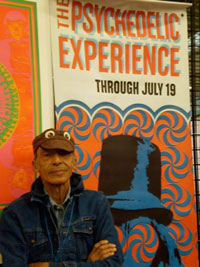
Photo: Justo Moscoso, CC BY-SA 3.0 (Wikimedia Commons)
Biography
Victor Moscoso was born July 28, 1936, in Vilaboa, in the Culleredo municipality of Galicia, Spain, near A Coruña. His family emigrated to Brooklyn around 1940 after his father fled Franco’s regime. He would become one of the defining visual voices of the 1960s counterculture — and the one with the most formal training.
Moscoso was, by broad consensus, the only rigorously trained fine artist among the “Big Five.” He studied at Cooper Union, then Yale under Josef Albers — the Bauhaus master whose investigation of color interaction would shape Moscoso’s entire visual language — then did graduate study at the San Francisco Art Institute, where he later taught.
The irony of his career is that he had to consciously unlearn his academic training to find his psychedelic style. From the fall of 1966 he designed posters for the Family Dog at the Avalon, then under his own Neon Rose imprint for the Matrix nightclub. He extended into underground comix joining Zap Comix at its second issue in 1968 (Crumb made the first solo).
Why They Matter
Moscoso brought trained, theoretical rigor to an otherwise self-taught art form. Where his peers arrived at the vibrating psychedelic aesthetic by intuition, Moscoso arrived by theory: from Albers he had absorbed how complementary colors of equal value, placed edge to edge, refuse to resolve and seem to shimmer. He weaponized that optical principle deliberately, and is credited as the first of the rock-poster artists to integrate photographic collage.
As the only academically educated member of the “Big Five,” Moscoso became the bridge between European modernism and street-level Haight-Ashbury psychedelia. His work is held by MoMA and SFMOMA; later honors include the AIGA Medal (2018).
Notable Works
- The Neon Rose series (1966–67) — his crown achievement, roughly seventeen-plus numbered posters celebrated for pulsating color and dissolving lettering.
- Neon Rose #1, Junior Wells (1966, the Matrix) — his breakthrough debut.
- Neon Rose #10, The Doors (1967).
- His Avalon / Family Dog posters (1966–67).
- Zap Comix covers and strips (1968 onward), marked by vibrating color and rigid grids.
- Later album covers for Jerry Garcia, Bob Weir, and Herbie Hancock.