

BG-141
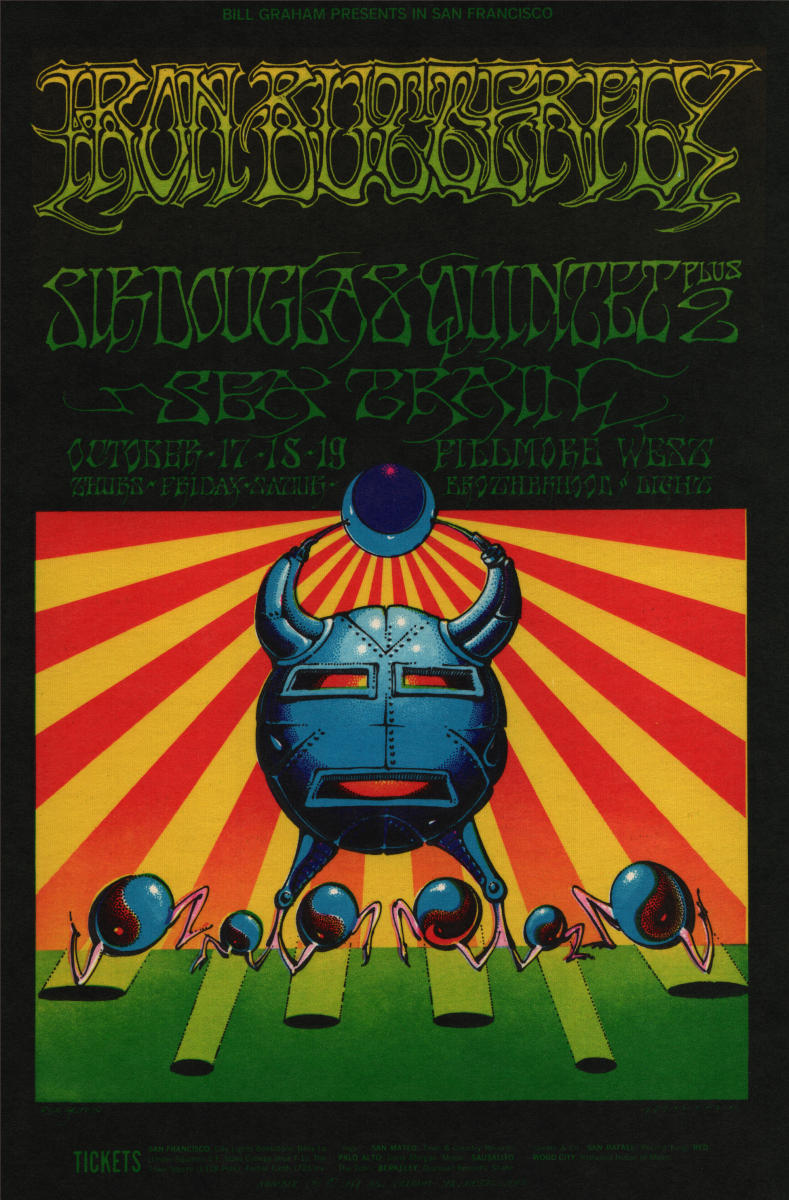
BG-141 · Victor Moscoso, Rick Griffin
San Francisco
Sir Douglas Quintet
Sea Train
On Thursday, October 17, 1968, Bill Graham opened a three-night weekend at the Fillmore West — the old Carousel Ballroom at Market and Van Ness that he had taken over that summer — with a bill that reads, in retrospect, like a snapshot of rock pulling in three directions at once. Topping it was **Iron Butterfly**, a band at the exact crest of its fame. Beneath them came the **Sir Douglas Quintet**, Doug Sahm's Tex-Mex outfit newly transplanted to the Bay Area, and **Sea Train**, a jazz-and-fiddle-inflected group assembled from the wreckage of the Blues Project. The run carried the catalog number **BG-141**, and it closed on Saturday the 19th. (The poster trade, it should be said, cannot agree on the weekday — Wolfgang's prints "Friday thru Sunday," another listing says "Wednesday–Friday"; both are wrong. The calendar is plain: Thursday through Saturday, Graham's usual Fillmore West weekend shape.)
The poster is the first thing worth lingering on, because it is one of the small handful of genuine two-hand collaborations in the whole Bill Graham series. BG-141 was drawn by **Rick Griffin and Victor Moscoso together** — the companion piece to **BG-140**, the Jimi Hendrix poster from the same stretch of Fillmore West dates. The two artists, already fused creatively through their work on *Zap Comix*, sat side by side with both art boards in front of them. Moscoso later said that after a while "it became difficult to tell where Rick drew and where I drew." Where BG-140 had carried a scarab, BG-141 reworked the motif into what the Wolfgang's description calls "trash burners with horns." It is a useful corrective to any assumption that late-1968 Fillmore posters were a Lee Conklin monopoly: this one is pure Griffin-and-Moscoso, and signed copies in the market bear Moscoso's hand (several bear both).
The headliner supplies the loudest story thread. Iron Butterfly's *In-A-Gadda-Da-Vida* had been released on **June 14, 1968**, and by this October weekend it was a genuine phenomenon — a long-charting album (it would eventually spend the better part of two years on the charts and sit atop Billboard's 1969 year-end album tally) built around a title track that ran **seventeen minutes and five seconds** and filled an entire side of vinyl. To book that band into the Fillmore West in October 1968 was to book the sound of the moment: the ponderous, organ-drenched, drum-solo-bearing proto-heavy-rock that the underground FM stations were spinning in full. Whatever one thinks of the record now, in that room that autumn it was the main event, and the billing order — Iron Butterfly first, large — reflects it.
The undercard is where the bill quietly tells a Bay Area story. The **Sir Douglas Quintet** had been, a couple of years earlier, a San Antonio band with a British-Invasion disguise and a national hit in "She's About a Mover." A 1966 drug bust in Texas had pushed Doug Sahm west, and by 1968 the reconstituted Quintet was a San Francisco act, soaking up the same Bay Area air as the headliners. The fruit of that relocation was still a couple of months off: **"Mendocino,"** Sahm's sunniest single, was released in December 1968 and climbed to around No. 27 on the Hot 100 in early 1969, with the *Mendocino* album following in April. So on October 17 the Quintet was a local band on the verge — the hit not yet out, the Northern California reinvention already audible.
**Sea Train** rounds out the bill and resolves a small spelling puzzle. The band — flutist-bassist **Andy Kulberg** and drummer **Roy Blumenfeld**, both lately of the Blues Project, with fiddler Richard Greene among the others — was a Marin County proposition folding bluegrass fiddle and jazz into rock. Their self-titled debut would not arrive until 1969, and it, too, used the two-word spelling **"Sea Train"** — which is exactly how the poster and the Chicken on a Unicycle listing render it. So the odd orthography on BG-141 is not a transcription error; it is the band's own early styling. On this October weekend they were the youngest proposition on the bill, a group whose record was still ahead of it.
Three acts, then, caught at three different clock-positions: Iron Butterfly at its commercial zenith, the Sir Douglas Quintet a hit away from its Bay Area breakthrough, Sea Train with everything still to prove — all of it wrapped in a poster that two of the era's greatest draftsmen made with four hands and one shared pen.
*(Meanwhile, across the years on this date: a year later, Oct 16–19, 1969, the Fillmore West weekend was Joe Cocker / Little Richard / The Move; and in October 1967 the San Francisco International Film Festival used the old Fillmore Auditorium. Both unverified this pass — color only.)*
Verification Notes
RESEARCHED+ANTAGONIZED 2026-10-06 (headless). Iron Butterfly / Sir Douglas Quintet / Sea Train, Fillmore West, Oct 17-19 1968 (Thu-Sat). check-claims OK (chickenonaunicycle+wolfgangs). DESIGNER CORRECTED: BG-141 is RICK GRIFFIN + VICTOR MOSCOSO (companion to BG-140, Zap-Comix-derived collaboration) -- verified Heritage + Bonhams + ConcertPosterGallery + Wolfgang's; NOT Lee Conklin. Poster-trade sources mislabel the weekday (Wolfgang's 'Fri-Sun', another 'Wed-Fri') -- dates unanimous, use Thu-Sat. In-A-Gadda-Da-Vida released June 14 1968 (17:05 title track); #4 chart peak is Wikipedia-single -> framed as 'massive long-charting hit', not a hard number. 'Sea Train' two-word spelling is the band's own (1969 debut). Bill pinned to the run. Browser-only (classicposters/famsf) for signature read.
Were You There?
Do you have memories of this show, or an original BG-141 poster? On This Day in Art Rock History celebrates the people who lived through the psychedelic era. Your stories and collections matter to this archive.
Comments